
#45 — Parshat Ki Tavo
Devarim 26:1-29:9
Overview
Our parsha starts with a liturgy of thankful rejoicing “in all the good that the L-RD your G-d has given you.” When Israel has come into the land it is to give the firstfruits of the harvest to G-d, confessing that it was the L-RD who took them out of Egypt and gave them the land. Then a declaration before the L-RD of having faithfully given the tithe to the Levite, sojourner, fatherless, and widow, is prescribed, together with a prayer for blessing (Deuteronomy 26:1-15).
Israel is admonished to do G-d’s commandments with all their heart. Moses says they have declared their allegiance to G-d and G-d has declared them to be His treasured possession. They will be His holy people, set high above all nations (Deuteronomy 26:16-19).
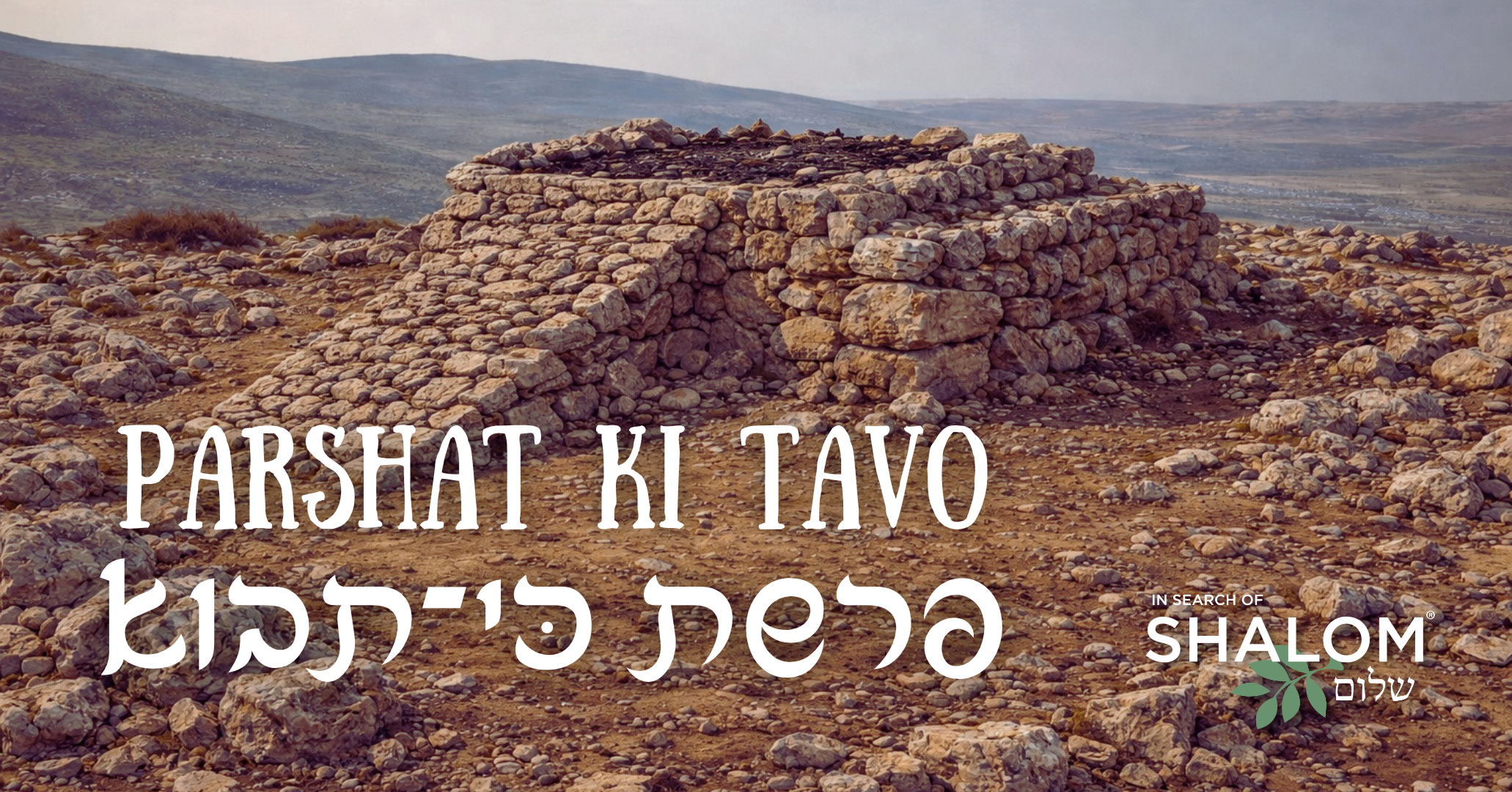
When Israel has entered the land it is to write the words of the law on plastered stones set up on Mount Ebal. There they are to build an altar, bring sacrifices, and rejoice before the LORD (Deuteronomy 27:1-8).
On the opposite side of Mount Ebal is Mount Gerizim, upon which six tribes are to pronounce the blessing following obedience. On Mount Ebal, six tribes are to pronounce the curse for disobedience. In addition, the Levites would pronounce cursed all who have committed more secret transgressions, all summarized with “cursed be anyone who does not confirm the words of this law by doing them” (Deuteronomy 27:8-26).
Moses then spells out how Israel will be blessed in the land when they are obedient (Deuteronomy 28:1-14), but also mirrors those blessings with terrifying curses for disobedience. These curses will make Israel perish from the land. Upon disobedience, Israel will be scattered among all the peoples and will even try to sell itself back as slaves in Egypt (Deuteronomy 28:15-68).
In chapter 29 (Hebr. Deuteronomy 28:69), our parsha begins recording an additional covenant which the L-RD made with Israel through Moses in the land of Moab. This additional covenant reinforces the covenant made at Sinai. It is a call to choose life by obedience to G-d’s law, but also adds a special promise of renewal upon repentance (Deuteronomy 29:1-30:20).
Moses says that Israel saw the great wonders which the L-RD had done, but so far the people have not been given a heart to understand (Deuteronomy 29:2-4).
He recalls the LORD’s miraculous sustenance (e.g., clothes and sandals didn’t wear out and Israel was sustained even though they ate no bread or wine). Then he recalls how Israel defeated the kings of Heshbon and Og (Deuteronomy 29:5-9).
“Therefore keep the words of this covenant and do them, that you may prosper in all you do” (Deuteronomy 29:9).
Rejoicing on Mount Ebal
Will the Torah result in blessing or in curse?
The main theme of our parsha is blessing and curse. Especially in Chapter 28, where Moses spells out blessings and terrifying curses which end in exile from the land. Which of the two will it be?
The first obvious answer to the question “Will the Torah result in blessing or curse?” is “That depends on whether or not Israel will obey the voice of the L-RD” (Deuteronomy 28:1, 15).
But then, there are bleak portents that things won’t end well. Ominously, the description of the curses is much longer than the description of the blessings. On top of that, Deuteronomy predicts that Israel will be disobedient to G-d and break His covenant (e.g., Deuteronomy 31:16,20, 27).
The words of the law have to be written plainly on plastered stones. But these stones are not erected on Mount Gerizim from which the blessing is to be declared, but rather on Mount Ebal, the mountain from which we hear the curse (Deuteronomy 11:29, 27:13). That again is foreboding. The Torah seems to stand on Mount Ebal as a “witness against us” (compare Deuteronomy 31:26), threatening curses.
Nevertheless our parsha contains a commandment to rejoice before the L-RD on Mount Ebal. “And you shall eat there and rejoice before the L-RD” (Deuteronomy 27:7).
This is because of something essential we should not overlook….
An altar in the right place
Israel is instructed to build an altar on Mount Ebal. “You shall build an altar to the L-RD your G-d of uncut stones. And you shall offer burnt offerings on it to the L-RD your G-d, and you shall sacrifice peace offerings…” (Deuteronomy 27:6-7).
Again sacrifice takes a crucial position. Just as in the days of Noah, sacrifice marks the transition from curse to blessing (Genesis 8:20-9:1). Just like sacrifices at the foot of Mount Sinai made it possible for the elders of Israel to come into G-d’s presence (Exodus 24:4-12), and just as it was sacrifice that made it possible for the L-RD to dwell among His people in the tabernacle (e.g., Exodus 29:38-43), so it is in this case also. Sacrifices are commanded right where they are needed.
The Torah’s “strategic” placement of sacrifice points us to the good news of the Messiah. He took our curse upon Himself in the ultimate sacrifice of His death for our sins.
Yes, the Torah alone, by itself, remains a witness against us. It keeps threatening curse for disobedience... But, when the Torah, according to its own prescriptions, is combined with atoning sacrifice it leads us to a place of rejoicing before the L-RD. Torah with Messiah’s sacrifice is blessing!
G-d’s unwavering purpose accomplished
In our parsha Moses also says, “the L-RD has declared today that you are a people for His treasured possession, as He has promised you. And that you shall keep all His commandments, and that He will set you in praise and fame and in high honor above all nations that He has made, and you shall be a people holy to the L-RD your G-d, as He has promised” (Deuteronomy 26:18-19).
Moses emphasizes “as He promised.” More than a mere promise of blessing after obedience, this also underscores G-d’s unwavering purpose which will be accomplished. Yes, Israel’s relationship with G-d will go through a deep crisis as Deuteronomy predicts. But ultimately Israel’s sins will be atoned for, Israel will turn to G-d in a definite way and will be forever G-d’s treasured possession. As we study our next parshas in the light of the prophets, we will see how this will all turn out.
Our parsha starts with a liturgy of thankful rejoicing “in all the good that the L-RD your G-d has given you.” That is revealing the heart of G-d. And that is also how He ordains Israel’s history will end:
I will turn their mourning into joy; I will comfort them, and give them gladness for sorrow. I will feast the soul of the priests with abundance, and My people shall be satisfied with My goodness, declares the Lord” (Jeremiah 31:13-14).